
Antenna Installation
High-speed, carrier-grade wireless connectivity
provides the backbone for modern business operations without the high costs or delays of traditional fiber trenching. Expert engineering teams design and deploy high-performance Point-to-Point (PTP) and Point-to-Multipoint (PTMP) microwave antenna systems tailored to maximize network reliability and throughput.
Here is professionally structured web content tailored for a wireless network infrastructure services company.
Enterprise Wireless Solutions
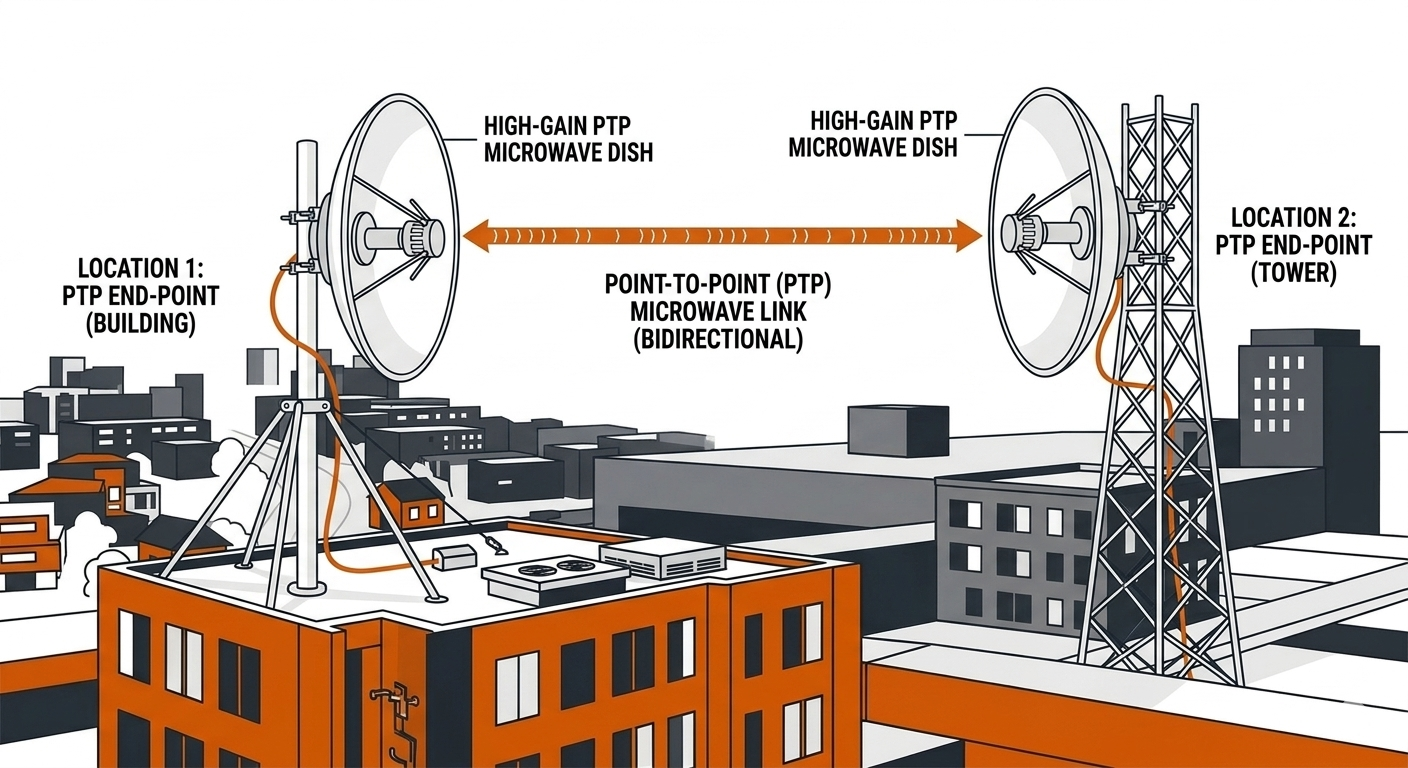
Point-to-Point (PTP) Microwave Links
Point-to-Point (PTP) microwave links deliver a dedicated, ultra-high-capacity wireless bridge between two specific geographic locations. This architecture provides the ultimate solution for high-throughput, low-latency data transport over short or long distances.
- Dedicated Bandwidth: Guarantees exclusive throughput without network sharing.
- Fiber-Like Speeds Achieves data rates from 1 Gbps up to 10+ Gbps.
- Long-Distance Reach: Connects facilities separated by miles or challenging terrain.
- Primary Applications: Ideal for building-to-building enterprise networks, backhaul, and redundancy.
Point-to-Multipoint (PTMP) Wireless Networks
Point-to-Multipoint (PTMP) architecture connects a single central base station to multiple remote subscriber locations. This topology provides an efficient, highly scalable method for distributing high-speed connectivity across a wide geographic footprint.
Cost-Effective Scaling
Reduces infrastructure costs by centralizing the broadcast hardware.
Rapid Deployment
Adds new remote sites quickly without rewiring the central hub.
Flexible Topology
Adjusts easily to dynamic campus environments and smart city layouts.
Primary Applications
Perfect for security camera networks, business parks, and localized ISPs.
PTP vs. PTMP Architecture Comparison
The choice between PTP and PTMP depends entirely on your specific infrastructure footprint, budget, and bandwidth requirements.
| Feature | Point-to-Point (PTP) | Point-to-Multipoint (PTMP) |
|---|---|---|
| Connection Type | One-to-one dedicated link | One-to-many shared distribution |
| Throughput Capacity | Ultra-high (Up to 10+ Gbps) | High (Shared aggregate bandwidth) |
| Maximum Range | Exceptionally long (Up to 30+ miles) | Medium (Typically localized to a few miles) |
| Hardware Required | Two matching directional antennas | One omni/sector antenna + multiple clients |
| Best Used For | Core backhaul & fiber replacement | Distributed campus & surveillance networks |
Our End-to-End Installation Process
- Line-of-Sight (LOS) Analysis: Engineers perform comprehensive software terrain modeling and physical site surveys to ensure an unobstructed pathway between antennas.
- Path Engineering & Frequency Coordinations:⦁ Teams calculate precise link budgets, select the optimal frequency bands (licensed or unlicensed), and secure necessary regulatory clearances.
- Structural Hardware Installation: Technicians secure heavy-duty mounts, non-penetrating roof sleds, or tower brackets engineered to withstand high wind loads.
- Precision Alignment & Commissioning: Installers utilize advanced telemetry tools to fine-tune azimuth and elevation, maximizing signal-to-noise ratios (SNR) for optimal stability.
- Post-Launch Testing & SLA Verification: Comprehensive bit-error-rate (BER) and throughput testing verify that the link meets or exceeds all performance agreements.